
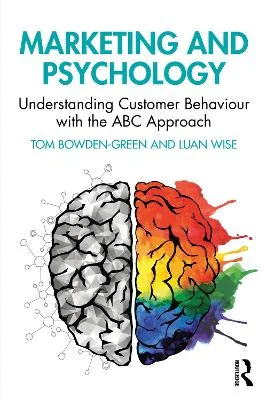
Description
By (author) Bowden-Green, Tom; By (author) Wise, Luan
Short /annotation:
This book explores how consumers behave by summarising relevant psychological theories and showing how these can be applied to marketing activities in practice. Exploring why we make purchases and how effective digital marketing can be, the book examines the psychological processes of decision-making relating to consumer behaviour.
:
This lively and engaging book helps marketers create more effective strategies and campaigns. It explores why customers behave the way they do, drawing on hundreds of psychological theories and showing how these can be applied to marketing practice.
The book presents a broad framework, grouping psychology theories together into a simple to follow ‘ABC’ approach: Understanding your audience, communicating brand perception and helping customers to make the right choice – posing key questions to consider. Understanding the basics of psychology gives invaluable insight into customer behaviour, whether in B2C, B2B, or non-profit contexts. Written by authors with expertise in both marketing psychology and marketing practice, the book presents the latest research in a way that will be accessible to all, guiding readers through the psychology underpinning marketing to understand human behaviour and explain what we know about how customers think.
Offering effective strategies to develop successful marketing plans, Marketing and Psychology is essential reading for marketing practitioners, from early career to seasoned professionals. It will also be relevant reading for students of marketing, consumer psychology, and advertising.
Table of contents:
Contents
About the authors
Contents
List of figures
Acknowledgements
Introduction
Chapter 1.
Marketing & Psychology in Practice.
Chapter 2.
Audience: Using Psychology for Segmentation.
Personality – five traits.
Personality – dark triad.
Intelligence.
Socioeconomics
Geography (culture)
Age.
Sex and gender
Chapter 3.
Audience: Customer Disposition.
Attitude.
Beliefs.
Values.
Morals.
Motivation.
Executive functions.
Self-evaluation.
Chapter 4.
Audience: Navigating Social Dynamics.
Relationships with others.
Using others as reference points.
Impression management
The influence of crowds.
Chapter 5.
Brand: Shaping Brand Perception.
Attention.
Cognition.
Emotion.
Branding.
Messaging.
Storytelling.
Language.
Humour
Memory aides.
Visual senses.
Aural senses.
Chapter 6.
Brand: Finding The Right Voices.
Judgement of people.
Likeability and authenticity.
Credibility.
Authority and status.
Chapter 7.
Choice: Embedding Your Brand in Memory.
Implicit and explicit memory.
Long-term v short-term memory.
Rumination.
Other memory effects.
Information processing.
Conditioning.
Chapter 8.
Choice: Recognizing Biases and Demonstrating Value.
Reference-dependence.
Loss and gain.
Time-related assessment
Effort
Ownership.
Choice.
Presentation of prices.
Self-control and decision-making.
Assessment of chance and logical fallacies.
Time perception when making decisions.
Involvement
Summary.
References.
Index.
Review quote:
“It’s my bible for understanding the hundreds of behavioural biases. The ultimate reference guide to decode human decision-making.”
Phill Agnew, host of the No.1 marketing podcast ‘Nudge’.
“You’ll refer to this book time and again. It’s the equivalent of having two experts on staf




Reviews
There are no reviews yet.